




Artificial intelligence is no longer just a productivity tool inside corporate offices. At firms like KPMG, it has also become something employees are measured against.
The consulting giant recently introduced an internal dashboard that tracks how often workers use AI tools during their daily tasks. The system was designed to encourage stronger AI adoption across its US advisory division, yet employees say the numbers can be manipulated with little effort.
The dashboard arrived at a time when companies across industries are under pressure to prove that expensive AI investments are paying off. KPMG believes regular AI usage can improve work quality, reduce stress, and free employees to focus on higher-level assignments.
Still, some workers question whether the tracking system actually measures meaningful productivity or simply rewards frequent clicks.
KPMG Introduces AI Usage Dashboard
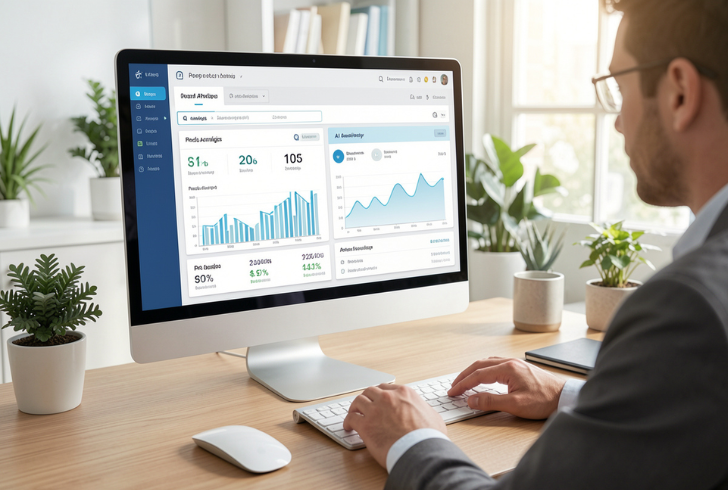
Freepik AI | A new KPMG dashboard enables 10,000 employees to monitor their AI adoption relative to team targets.
KPMG confirmed that the dashboard was launched for its 10,000-person US advisory division late last year. The tool allows employees to compare their AI activity against team goals and peer performance.
The company recently cut 400 jobs in the same division, which added more attention to the rollout. According to KPMG spokesperson Russ Grote, the initiative is meant to push employees toward “frequent and sophisticated” AI use rather than occasional experimentation.
Grote told Business Insider, “Our data shows regular AI users produce higher-quality work, feel less stressed, and spend more time on strategic work.”
He also said those benefits may help employees advance faster while improving service for clients going through AI-related business shifts.
KPMG claims that more than 90% of its US workforce now uses AI tools every week.
Employees Say the System Is Easy to Manipulate
Despite the company’s goals, some workers argue the dashboard does not fully reflect real AI adoption. Two employees who spoke anonymously to Business Insider explained that the system mainly tracks whether a tool was opened or prompted, not how effectively it was used.
One employee claimed a simple prompt submission could count as AI usage for the entire day. Another noted that automated prompts could even run during weekends to keep scores high without meaningful interaction.
The dashboard reportedly tracks activity across several approved tools, including KPMG’s internal platform aIQ Chat. The platform provides secure access to large language models such as ChatGPT, Claude, and Gemini. KPMG also uses Digital Gateway, an AI-powered system developed to help teams prepare for changing tax regulations.
Employees in many departments are expected to reach a 75% usage target. That figure means AI tools should be used on roughly three out of every four business days.
One worker pointed out that some widely used coding tools, including Lovable and Claude Code, are not included in the tracking system. That omission may leave out a large portion of real AI-assisted work completed by software engineers.
AI Tracking Expands Across Corporate America

Instagram | thetathyanews | JPMorgan now tracks and ranks its developers based on their GitHub Copilot and Claude usage.
KPMG is not the only company measuring employee interaction with AI. Similar systems are appearing across banking, entertainment, and tech companies as executives search for measurable returns on AI spending.
At JPMorgan Chase, developers in the company’s 65,000-person technology division are being monitored through internal dashboards that track usage of coding assistants such as GitHub Copilot and Claude. Engineers are reportedly ranked based on how frequently they use the tools.
Disney also tracks employee AI usage, including how often tools are used and how many tokens workers generate during a set timeframe.
At Amazon, teams reportedly review how many engineers use AI each month and whether those tools are improving actual workflows rather than simply increasing activity numbers.
These systems reflect a growing shift in workplace culture. AI adoption is now being measured much like sales targets or productivity metrics.
KPMG Pushes for “Sophisticated” AI Usage
KPMG leadership says the company has moved beyond basic AI adoption. CEO Tim Walsh previously told Business Insider that employees are strongly encouraged to use AI because “it’s critical to your success in the future.”
The company insists the dashboard is only one part of a broader AI initiative. Grote said KPMG focuses on incentives rather than penalties.
One example is the “AI Spark Innovation Awards,” launched earlier this year inside the advisory division. The program offers cash rewards to consultants who show creative ways AI can solve business problems.
KPMG also partnered with The University of Texas at Austin to study how employees achieve stronger AI outcomes.
According to Grote, the research found that the highest-value users were not necessarily the most technical workers. Instead, the most successful employees treated AI “like a true partner,” guiding systems through complex tasks with repeated interaction and refined prompts.
Corporate AI dashboards are changing how companies evaluate workplace performance. KPMG’s tracking system highlights a growing belief that AI adoption should be measurable, visible, and tied to employee development. At the same time, worker concerns reveal the limits of usage-based metrics.
Opening an AI tool does not always equal productive work. As businesses continue investing heavily in artificial intelligence, companies may face increasing pressure to measure quality instead of simple activity counts.