





Many businesses look successful on the surface. Revenue increases, customers grow, and operations stay active. Still, problems often build quietly underneath. When leaders rely on instinct instead of financial data, decisions lose accuracy. Over time, that gap creates risk that most businesses do not notice until it becomes serious.
Financial data works as a decision guide, not just a reporting tool. It shows how a business actually performs beyond surface-level activity. While revenue may look strong, profit often tells a different story. Likewise, busy operations do not always mean healthy margins.
Financial data also helps leaders understand timing. A decision that looks good today may not work tomorrow if cash flow cannot support it. Because of that, businesses that ignore financial data often react instead of plan.
A QuickBooks study found that 60% of small business owners struggle with financial knowledge. Consequently, many miss warning signs that affect profit, stability, and long-term growth.
The Three Questions Behind Every Smart Decision
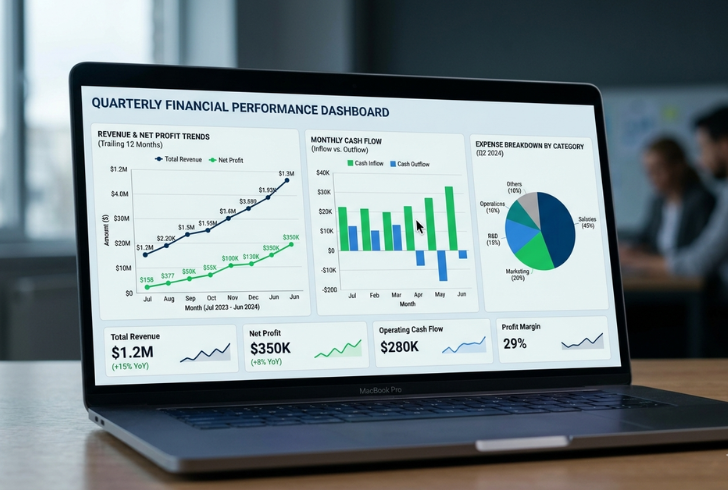
Gemini AI | Financial data helps businesses plan ahead, spot risks early, and make smarter decisions.
Every important business decision connects back to three simple financial questions. These questions shape hiring, pricing, and expansion choices.
1. Can the business afford this move?
Cash flow is more important than revenue when making business decisions. Before taking any step, businesses need a clear understanding of their actual liquidity. This means closely monitoring key factors such as the current cash balance, monthly expenses, and burn rate along with runway.
Without these numbers, even fast-growing companies can face sudden cash shortages. Therefore, cash clarity protects survival.
2. Will this decision generate profit?
Growth alone does not guarantee success. Profitability decides long-term strength.
Businesses must evaluate key financial metrics such as gross profit margins, net profit margins, and contribution margins to better understand their profitability and overall financial performance.
If margins stay weak, scaling only increases financial pressure. So, profitability must guide every expansion step.
3. What return will this investment create?
Every expense in a business should generate clear, measurable value; otherwise, it simply becomes a cost without purpose.
To ensure spending is effective, it’s important to track key financial metrics such as customer acquisition cost (CAC), lifetime value (LTV), and the payback period
When these numbers stay unclear, businesses spend without direction. However, clear returns turn spending into investment.
Financial Data That Actually Matters
Not every metric helps decision-making. Still, a few key indicators provide full clarity.
1. Cash Flow - Cash flow tracks money in and money out. It remains the most important survival metric. Businesses often fail not due to low profit, but due to poor cash timing.
2. Profitability - True profitability shows real performance after all costs. It also includes owner compensation. This figure confirms whether the business model works.
3. Revenue Breakdown - Revenue sources reveal what drives growth. Businesses should track income by product or service, customer type and sales channel. This breakdown shows what to scale and what to reduce.
4. Cost Structure - Cost structure separates fixed and variable expenses. This clarity helps identify inefficiencies. It also exposes hidden profit leaks that reduce margins over time.
Turning Financial Data into Strong Decisions

Gemini AI | Strong businesses use financial data to guide hiring, pricing, and growth decisions wisely.
Data only creates value when businesses apply it correctly. Strong companies use numbers to guide action instead of emotion.
For hiring decisions, businesses avoid rushing. They hire only when cash flow supports payroll and the role improves efficiency or revenue. Otherwise, hiring becomes a financial burden.
For pricing decisions, companies avoid copying competitors. Instead, they set prices based on margin strength and long-term sustainability.
For scaling decisions, timing plays a major role. Businesses expand only when operations stay stable, margins remain strong, and cash flow supports growth.
Financial Clarity Builds Business Control
A clear understanding of financial data allows leaders to make faster, more confident decisions because they can rely on accurate numbers rather than guesswork.
This clarity helps businesses hire more intentionally, set strategic pricing, and scale operations in a controlled way, ultimately reducing risks and avoiding costly mistakes.
Financial data is not just a tool for tracking performance—it serves as a foundation for strong leadership and informed decision-making at every level. Companies that overlook it often face uncertainty and instability, while those that consistently use financial insights build a more structured, resilient, and growth-focused business.
In the long run, success comes from understanding financial realities and using that knowledge to make smart, confident decisions.